The Import One‑Stop Shop (IOSS): A Professional Overview of EU E‑Commerce Import VAT Compliance
The EU Import One‑Stop Shop (IOSS) simplifies VAT collection for low‑value B2C goods imported into the EU under €150. This guide covers eligibility, registration, intermediary duties, compliance risks and logistics best practices for cross‑border sellers and fulfilment operators.
Introduction
The Import One‑Stop Shop, commonly abbreviated as IOSS, is a special EU VAT scheme introduced on 1 July 2021 alongside broader e‑commerce VAT reforms, replacing the historic VAT exemption for low‑value consignments under €22Agencia Tr.... Designed to streamline VAT administration for distance sales of goods imported from third countries or third territories to non‑taxable private consumers within the European Union, IOSS eliminates the need for multiple national VAT registrations and post‑delivery VAT collection from end buyers. It forms one of three pillars of the EU One‑Stop Shop (OSS) framework, alongside the Union OSS and Non‑Union OSS schemes, yet it is exclusively dedicated to imported low‑value parcelsVAT One St....
Prior to the 2021 reform, small cross‑border parcels below the €22 threshold entered the EU VAT‑free, creating uneven competition between domestic EU merchants and overseas sellers, alongside substantial VAT leakage. The reform removed this relief and established IOSS as an optional compliance pathway for eligible consignments, enabling sellers to collect destination‑state VAT at checkout rather than leaving VAT settlement to customs authorities or final consumers upon deliveryTaxation a....
Core Eligibility Criteria
IOSS applies only when all three mandatory conditions are satisfied:
- The goods are located outside the EU at the moment of sale and imported into an EU Member State for delivery to a private consumer (B2C transaction);
- The intrinsic value of the individual consignment does not exceed €150; freight, insurance and other service charges are generally excluded from this valuation unless bundled into the product price;
- The goods are not excise‑goods such as alcohol, tobacco or perfumes subject to excise duty regimes, which remain outside the scope of IOSSRevenue Co....
The scheme is open to taxable persons established within the EU, non‑EU taxable persons, and electronic marketplaces acting as “deemed suppliers”. An important distinction applies to non‑EU businesses without an EU establishment: they must appoint an EU‑based IOSS intermediary to complete registration, file returns and assume joint liability for VAT payment. EU‑established sellers may register directly with the tax authority of their chosen Member State of Identification without an intermediaryRevenue Co....
It is critical to note that IOSS is voluntary. Where a seller declines to use IOSS, import VAT may still be collected at the border from the recipient, which often causes delivery delays, extra handling fees and poor customer experience.
How IOSS Operates End‑to‑End
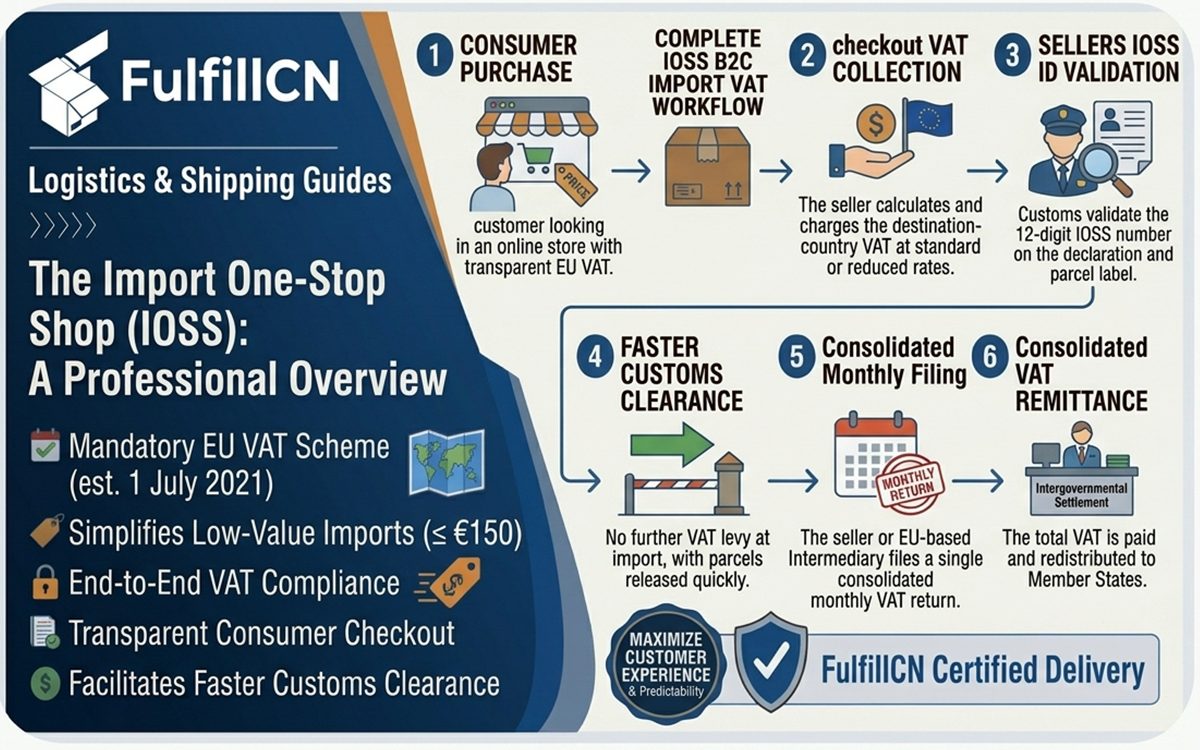
Under the destination VAT principle, VAT is charged at the standard or reduced rate applicable in the buyer’s Member State, not the seller’s home jurisdiction. The workflow follows four sequential stages:
- Checkout VAT collection: At the point of purchase, the seller calculates and charges the correct EU destination‑country VAT from the consumer. This VAT is shown transparently to the buyer before payment.
- Customs declaration with IOSS ID: The unique 12‑digit IOSS identification number is printed on the customs declaration and parcel label. Customs authorities validate the IOSS reference and confirm that VAT has already been accounted for; no further VAT levy is applied at import, enabling faster clearance.
- Monthly VAT return filing: The registered holder or appointed intermediary submits a single consolidated monthly IOSS VAT return to the Member State of Identification. Returns break down sales by destination Member State and applicable VAT rate. Nil returns are still required for months with no qualifying sales activityGOV.UK.
- Consolidated VAT remittance and revenue distribution: The seller pays the total VAT declared to the tax authority of the Member State of Identification. That authority redistributes the corresponding VAT amounts to the tax administrations of the destination Member States via EU intergovernmental settlement mechanismsEuropean U....
Registration, Intermediary and Record‑Keeping Obligations
Registration takes place through the IOSS portal of one selected EU Member State, which becomes the Member State of Identification. Once approved, the taxable party receives a dedicated IOSS VAT number for import declarations. A single IOSS registration covers all eligible B2C low‑value imports across the entire EU, removing the administrative burden of separate VAT registrations in every country of sale.
The role of the EU‑based intermediary is central for non‑resident sellers. The intermediary is contractually and legally responsible before tax authorities for filing returns, remitting VAT and maintaining audit trails, even though the underlying VAT liability rests with the supplier. Intermediaries must perform ongoing due diligence on represented sellers to mitigate fraud and non‑compliance risksRevenue Co....
Mandatory record retention applies for a minimum of ten years. Records must include order data, customer location evidence, product valuations, VAT rate calculations, customs documentation, payment receipts and shipping manifests, available for inspection by tax and customs authorities of any EU Member State. Inadequate record‑keeping, misdeclared consignment value or incorrect VAT coding can trigger audits, penalties and IOSS registration revocation.
Key Risks, Limitations and Common Misconceptions
A frequent misunderstanding is that IOSS removes customs duties. IOSS only simplifies VAT collection. Where a consignment is subject to customs duty (for example, certain textile, electronic or regulated goods), duty remains payable separately, even when IOSS is used. The €150 cap is per individual consignment, not per customer cumulative order; splitting a single commercial shipment into multiple parcels artificially to stay below the threshold constitutes a non‑compliant practice.
Marketplace liability is another high‑impact area. Under the deemed supplier rule, online platforms that facilitate sales by non‑EU sellers to EU consumers are treated as the supplier for VAT purposes. In such cases, the marketplace collects VAT and holds the IOSS registration, releasing the underlying merchant from separate IOSS obligations, provided the platform meets all compliance requirementsEuropean C....
Failure to comply can lead to customs detention of parcels, retrospective VAT assessments, interest, administrative fines and exclusion from the IOSS scheme. Customs authorities may reject an IOSS declaration if the IOSS number is invalid, mismatched, or the consignment value exceeds €150.
Regulatory Outlook: ViDA and IOSS Reform
The EU’s VAT in the Digital Age (ViDA) package introduces incremental improvements to IOSS governance and controls from 2027 onward, strengthening cross‑member‑state data exchange and anti‑fraud instruments for IOSS transactions. While the €150 threshold remains in place for the current legislative cycle, ongoing EU customs reform discussions explore potential adjustments to low‑value import rules in the medium term. Businesses should monitor European Commission guidance to adapt processes ahead of future changesTaxation a....
Practical Implications for Cross‑Border Fulfillment and Logistics
For fulfilment providers, freight forwarders and e‑commerce merchants, IOSS is a customer‑experience and operational tool. It reduces border friction, avoids cash‑on‑delivery VAT charges and improves delivery predictability. Logistics teams must ensure the IOSS identifier is correctly populated on CN22, CN23 or electronic customs declarations, alongside accurate intrinsic value marking. Warehouse and shipping workflows need validation rules to flag consignments exceeding €150 or containing excise goods, which cannot use IOSS.
Conclusion
IOSS represents the EU’s core harmonised mechanism for VAT on low‑value B2C imports, balancing tax revenue integrity with practical simplification for global online retail. While optional, it has become the preferred compliance route for most overseas sellers shipping small parcels to EU consumers. Successful IOSS implementation depends on precise eligibility screening, accurate destination‑rate VAT calculation, robust customs documentation, disciplined monthly filing and long‑term audit‑ready record management. Non‑EU operators must carefully select a compliant EU intermediary to manage legal exposure, while marketplace sellers should clarify deemed‑supplier responsibilities before deciding whether to secure their own IOSS registration.
